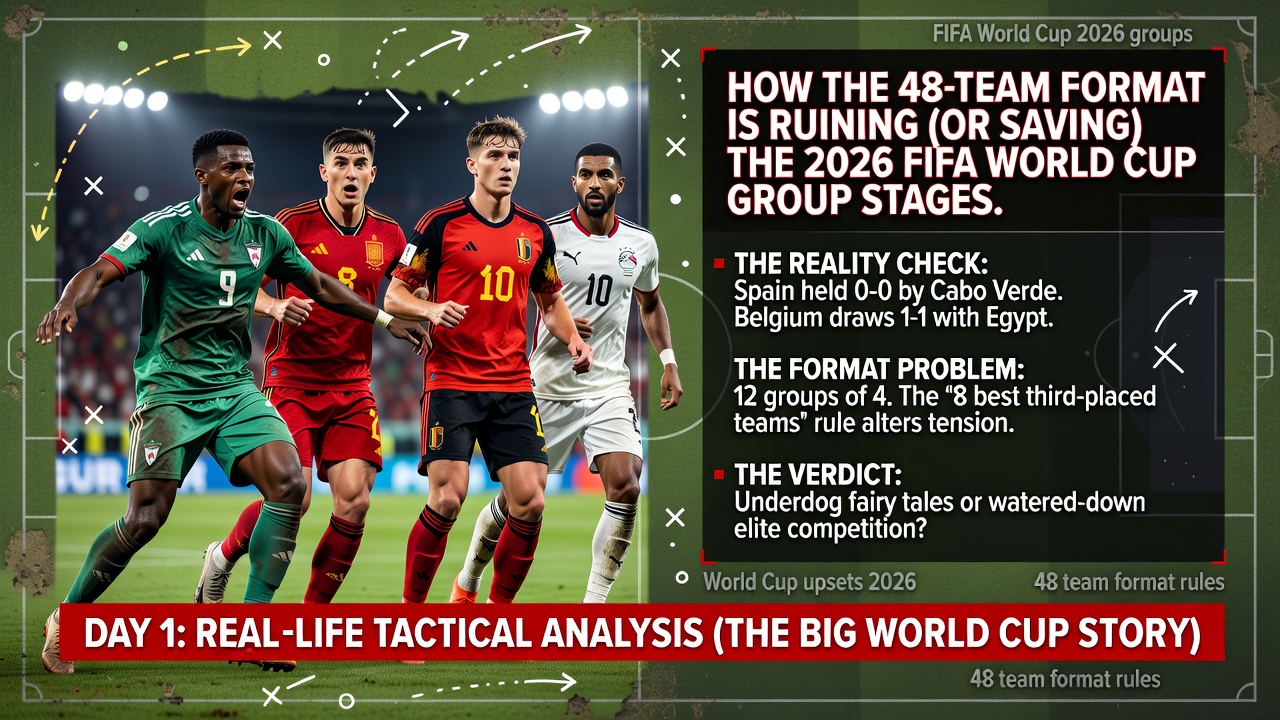
There’s a moment in every World Cup where the football world collectively loses its mind. Sometimes it’s a Senegal beating France. Sometimes it’s South Korea sending Italy home. On Day 1 of the 2026 FIFA World Cup, that moment arrived twice before most fans in Southeast Asia had even finished their morning coffee.
Spain held scoreless by Cabo Verde. Belgium, one of the pre-tournament favourites, scrapping for a 1–1 draw against Egypt.
The internet erupted. Pundits scrambled. And somewhere in the middle of all that noise, a quieter but far more important conversation started bubbling up — one that goes beyond the results themselves and cuts right to the heart of how this tournament is actually structured.
Is the 48-team format a masterstroke of football democracy? Or is it quietly, systematically draining the life out of the group stages?
Let’s dig in.
The Reality Check: What Actually Happened in Week One
Before we get into the philosophy, let’s talk about what unfolded on the pitch, because the football was genuinely extraordinary — and genuinely chaotic.
Spain 0–0 Cabo Verde
If you told a football fan five years ago that the reigning European champions, a side built around the relentless positional genius of their La Liga core, would be held completely scoreless by a nation of roughly 500,000 people, they’d have laughed you out of the room.
They’re not laughing now.
Cabo Verde came into this game with a clear, disciplined tactical identity — a low block that was almost aggressive in its organisation, a 4–4–2 that didn’t just park the bus but actively invited Spain to try and break them down through the middle. Their defensive line was compact, their transitions were purposeful, and crucially, their goalkeeper was absolutely inspired.
Spain had 78% possession. They created 19 goal attempts. They had corners, free kicks, and all the territory a team could reasonably want.
They got nothing.
What this result tells us tactically is fascinating. Spain’s build-up play, so fluid and devastating against high-pressing opposition, becomes almost predictable when a team refuses to engage and simply lets them circulate the ball in non-threatening areas. The quick vertical passes that unlock high lines found no gaps here because Cabo Verde offered no high line to exploit.
For Spain, it’s a stumble. For Cabo Verde, it’s one of the great results in their footballing history — and, in the context of the new format, something with genuine strategic value.
Belgium 1–1 Egypt
If the Spain result was a shock, the Belgium draw felt like a statement.
Belgium have been quietly rebuilding since their golden generation started ageing out. The squad still carries talent — the creative depth, the Premier League quality throughout the spine — but this was a performance that exposed real questions about their cohesion under pressure.
Egypt were organised, physical, and tactically astute. They pressed with real intensity in the first twenty minutes, disrupting Belgium’s rhythm in midfield before it could even establish itself. When they scored, it wasn’t a fluke — it came from a well-rehearsed set-piece sequence that Belgium’s defensive shape simply didn’t account for.
Belgium equalised, yes. But they never looked comfortable. They never looked like a team that was going to kick on and win this decisively.
For Egypt, who have a passionate supporter base stretching from Cairo to communities across Europe, the Middle East, and North Africa, this was the kind of result that travels. It matters emotionally, culturally, and — under the new rules — it matters mathematically too.
Which brings us to the real story here.
The Format Problem: 12 Groups, 48 Teams, and the Rule That Changes Everything
The 2026 FIFA World Cup is the first edition of the tournament to use the expanded 48-team format. To understand why results like Spain drawing with Cabo Verde feel different in 2026 than they would have felt in 2014, you need to understand exactly how this format works.
Here’s the structure:
- 48 nations divided into 12 groups of 4 teams
- The top two from each group advance automatically — that’s 24 teams
- The 8 best third-placed teams from across all 12 groups also advance — that’s 8 more
- Total: 32 teams move into a round of 32
On paper, this sounds like a sensible expansion. More nations, more stories, more football. And FIFA’s argument is straightforward — why should a talented nation from CONCACAF or CAF be denied a seat at the table simply because geography limited their qualifying spots?
The problem isn’t the inclusion. The problem is what happens to the mathematics of jeopardy.
The “Best Third-Place” Rule and Why It Matters
In a traditional 32-team World Cup with 8 groups of 4, third place meant you went home. Full stop. No arguments, no appeals, no second chances.
That brutal simplicity created something intangible but incredibly valuable — genuine, throat-tightening tension in every group stage match. When Germany drew against Sweden in 2018 and needed Toni Kroos to score a 95th-minute free kick just to stay alive, that moment was so visceral precisely because elimination was absolutely real and absolutely immediate.
Now, run those numbers through the 2026 filter.
If you finish third in your group, you still might qualify. In fact, statistically, finishing third means you have a strong chance of progressing as one of those 8 best third-place teams. The cutoff for what constitutes a “qualifying” third place will vary group by group, but early projections and similar expanded formats suggest that 4 points from 3 games — winning one, drawing one, losing one — is likely enough to get you through.
What does this mean tactically and emotionally?
It means a team can lose their opening game and rationally decide that going all-out in game two carries unnecessary risk. A draw, tactically managed, might be the safer bet. It means the conservative, low-block, don’t-lose-by-too-much approach has a strategic logic that simply didn’t exist before.
And when the elite teams know this — when Spain knows that Cabo Verde realistically needs only a draw and careful game management to keep their hopes alive — it fundamentally changes what the opposition is actually trying to do.
The Logistics of 12 Groups Running Simultaneously
There’s another layer here that the casual viewer often misses — the sheer logistical complexity of tracking 12 simultaneous group tables.
In 2018 and previous editions, eight groups meant eight clear narratives. Fans could follow the story of Group F or Group C without needing a spreadsheet. Now, with 12 groups and the added variable of “which third-placed teams qualify,” even dedicated supporters are struggling to track what results in one group mean for teams in another.
This isn’t just a fan experience problem. It creates genuine uncertainty for the teams themselves. A manager in Group K might not fully understand their qualification scenario without seeing how results are unfolding simultaneously in Groups G, H, and J. The tactical decision-making becomes partly reactive to information that isn’t even complete yet.
It’s football as live data analytics, and not everyone signed up for that.
The Underdog Argument: Football Democracy or Competitive Dilution?
Let’s be honest with both sides of this debate, because the knee-jerk reactions — either “this is amazing for small nations!” or “this is ruining football!” — both miss important nuance.
The Case FOR the Expanded Format
Cabo Verde holding Spain to a draw is exactly the kind of story that football needs. Here is a nation that has been systematically underrepresented in global football, a team built largely from diaspora players across Portugal and other European countries, playing with real tactical intelligence against one of the most sophisticated sides on the planet.
Their manager’s preparation was meticulous. Their players executed a game plan with composure and discipline that elite clubs would be proud of. And because of the expanded format, they came into that game knowing their result had genuine value — not just symbolically, but mathematically.
That changes how they prepare. That changes how seriously they train, how detailed their tactical work becomes. In previous tournaments, Cabo Verde wouldn’t even have been in the room. Now they’re holding Spain scoreless on Day 1.
For fans across West Africa, across the Cape Verdean diaspora in Boston, Lisbon, Rotterdam, and beyond — this is the World Cup working exactly as it should. Inclusivity isn’t just a buzzword here. It’s creating real, competitive, emotional football.
The same logic applies to Egypt and their performance against Belgium. A nation of 100 million people with a passionate footballing culture, historically underserved by qualifying formats that didn’t account for CAF’s actual depth of quality, finally getting a stage where they can demonstrate genuine tactical sophistication.
Football globally is broader and deeper than a Eurocentric competition structure has ever given it credit for. The expanded format, at its best, is a corrective.
The Case AGAINST the Expanded Format
But here’s where it gets complicated, and where the tactical analyst in me starts to feel genuine unease.
The group stages of a World Cup used to be about more than just qualifying. They were about establishing dominance. About sending a message. About the psychological work that a team does before the knockouts even begin — the building of momentum, the sharpening of combinations, the systematic dismantling of opposition game plans.
When Spain draws 0–0 with Cabo Verde, they don’t lose sleep over their qualification chances. They’re almost certainly going through. But they’ve learned nothing useful about breaking down a defensive block, because one goalless draw doesn’t generate the pressure needed to force tactical evolution.
The elite teams can, in theory, sleepwalk through a group stage that no longer carries the same existential threat. And teams that should theoretically struggle — that would have been exposed and eliminated in a tighter format — might accumulate points through careful management rather than genuine quality.
There’s also the issue of match intensity. When both teams in a group stage game have plausible reasons to avoid risk, you get more conservative, less entertaining football. The 0–0 between Spain and Cabo Verde, while historically significant, was not a spectacle. Nobody watching it for the football itself came away satisfied.
Multiply that across 12 groups and several rounds of “safe” results, and you potentially end up with a bloated early tournament that dilutes the atmosphere before the knockouts bring genuine edge.
The Tactical Verdict: What Smart Teams Will Do Differently
Here’s where experienced football observers will start to notice real adaptation in how teams approach the 2026 group stages — and it’s worth spelling out explicitly.
Rotation Will Be Aggressive
With qualification more accessible and the third-place safety net in place, elite managers will rotate their squads more aggressively across three group games than they ever would have before. Why risk Kylian Mbappé or Lamine Yamal in game two of three when progression is already secured? Rest them. Manage their physical load. Arrive at the round of 32 fresh.
This is the right managerial decision. But it’s not always great for the spectacle.
The Block-and-Counter Blueprint Is Now a Proven Strategy
What Cabo Verde demonstrated against Spain isn’t new tactically — but the format now validates it as a genuine route to qualification rather than just a brave attempt at a draw. Expect to see more teams across the African, Asian, and CONCACAF contingents arrive at the 2026 World Cup with rigorously drilled defensive structures and a clear focus on set pieces and counter-attacks as their primary attacking mechanisms.
This isn’t negative football. It’s intelligent football. But purists who want to see open, high-tempo attacking play in the group stages may be waiting until the knockouts.
Group D Dynamics and the Real Numbers Game
What the “8 best third-place teams” rule creates is a situation where a team can mathematically calculate exactly how many points they need from their remaining games based on what’s happening across the entire tournament simultaneously. Managers and analysts will be watching other groups obsessively, making in-game decisions not just based on the match in front of them but on data coming in from three other venues at the same moment.
This is modern football management at its most sophisticated. It’s also, if we’re being blunt, a bit exhausting to follow as a fan.
Where Does This Leave Us?
One day into the 2026 FIFA World Cup, the expanded format has already delivered exactly what its architects promised and exactly what its critics feared — simultaneously.
The underdog stories are real. Cabo Verde’s result against Spain will be talked about in Praia and in diaspora communities around the world for decades. Egypt’s draw against Belgium carries genuine footballing and cultural weight. The format is doing something meaningful for global football.
But the competitive structure does raise legitimate questions about whether the group stages still serve their traditional function — the culling of the field through pressure, intensity, and the real, immediate threat of elimination.
The 48-team World Cup is not ruining football. But it is changing what the group stages are for, and that change demands that fans, analysts, and perhaps even the players themselves recalibrate their expectations.
The tournament isn’t a 64-game elimination marathon. It’s a tiered event now — a broadly inclusive group phase followed by a knockout competition that, from the Round of 32 onwards, still has all the jeopardy and drama anyone could want.
The question is whether we can enjoy both chapters for what they are, rather than demanding each of them be something they’re not designed to be.
Because if Cabo Verde are still in this tournament when the knockouts start? That’s a story the whole world will be watching.
Tags: FIFA World Cup 2026 groups | World Cup upsets 2026 | 48 team format rules | World Cup 2026 analysis | Spain Cabo Verde | Belgium Egypt | World Cup tactical analysis | 2026 World Cup group stage | expanded World Cup format | football 2026